

Bogged Down: Kettle Bogs
+ a boggy cast of characters

A grad student studying lichens, her undergrad assistant, a mushroom-loving watercolorist, and a poet got on a boat piloted by a tattooed town justice with a reptilian surname. It sounds like the beginning to a meandering joke that ends with a disappointingly groan-worthy pun. Instead, it was just another day as a writer-in-residence in the Adirondacks.
As far as I can tell, there’s only one road, Route 3, that leads to Cranberry Lake, the third largest lake in Adirondack Park. Route 3 skirts around the northernmost edge of the lake, accessing Birch’s Lakeside General Store (where they sell some pretty tasty ice cream flavors), the fire department, a community library, a motel, and a boat launch. The southern half of the lake, where I was staying, is only accessible by boat. So, if I wanted to go anywhere other than the research station, I had to either canoe there or hitch a ride on one of the motorboats that ran on a schedule to connect the roadless residents with the outside world.
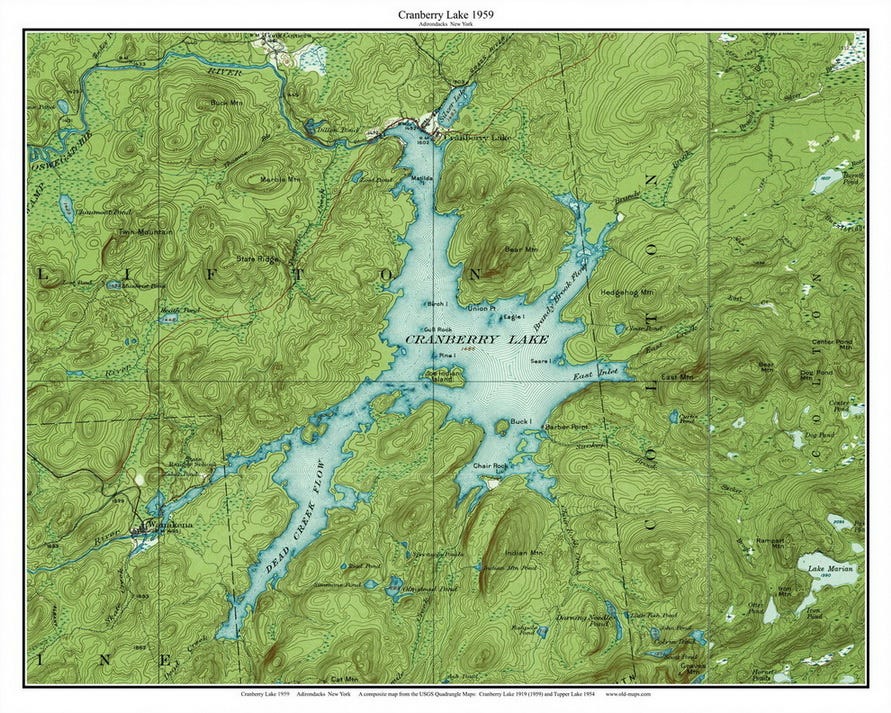
Our excursion this day took us to the SUNY-ESF Ranger School at Wanakena, on the southwest arm of the lake. The boat driver dropped our group of four off at a partially sunken dock on the edge of an old-growth forest. We had to leapfrog carefully from boat to shore to avoid slipping into the water. Once onshore, we were on our own - with no cell service, only a 2 o’clock rendezvous when the boat would return for us.
I was thrilled. Our objectives were various: the grad student and her assistant wanted to hunt the area for lichens. The watercolorist wanted to collect mushrooms for her illustrating project.
I wanted to see a bog. I had heard that in this area was a specific type of bog — a kettle bog. When the glaciers from the last ice age retreated, they left scars on the landscape. A “kettle” is a depression formed by a pocket of stubborn ice that became surrounded by sediment brought in by floodwaters from the melting glaciers. When the ice finally melts, a hole remains, often filled in with water, becoming a kettle lake.
If decomposing plant matter overwhelms the lake and makes it acidic, the kettle lake becomes a kettle bog. If you recall the discussion of bogs in my previous post, like other bogs, this kettle bog is only fed by rainwater or other kinds of precipitation.
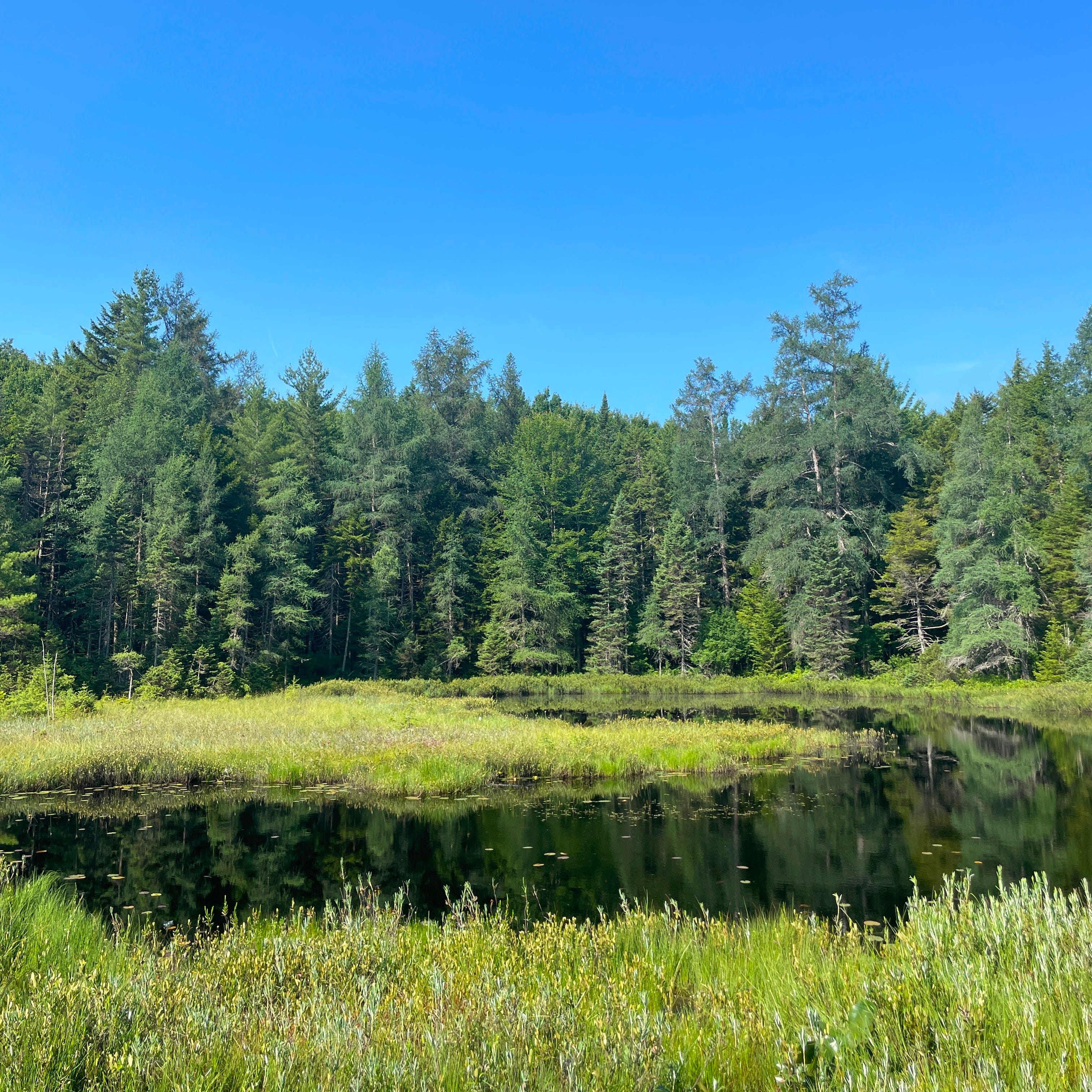
We passed through the woods — encountering a white oak so old and enormous I couldn’t see where its branches ended — and found ourselves among tamaracks. The tamaracks opened up onto a sunny pond — our kettle bog. The ground glittered with water and the dewy leaves of Drosera plants. What surprised me most was the springiness of the ground. The surface was built of layer upon layer of sphagnum moss. Many different species carpeted the ground, colored an autumnal red or lime green. As the generations of mosses decayed, they built the ground that I stood on. If I jumped, the ground quivered like a trampoline, shaking a nearby tamarack sapling. I abandoned my shoes at the forest edge and stepped out onto the soft, squishy moss.


I squealed with delight when I discovered, almost immediately, a white fringed orchid (Platanthera blephariglottis). For several years now, I had been searching for its cousin, the orange fringed bog orchid, in Florida. Its beautiful milky plume waved above the sphagnum moss, beckoning me closer. It grew singly or in clumps, and I had the joy of stumbling upon more of them as I slogged through the bog.
Some other delightful inhabitants of the kettle bog were the purple pitcher plant (Sarracenia purpurea), rose pogonia (Pogonia ophioglossoides), and golden strands of bladderwort (Utricularia spp.). The purple pitcher plant had shot up from its pale green stalk a maroon flower. Below, its leaf gaped its darkly veined throat, hungry as a frog. A species of pitcher plant (Sarracenia rosea) is found on the Gulf Coast of Florida, and used to be classified as a variety of S. purpurea. I had discovered it once a few years ago in a ditch in the Apalachicola National Forest, so it was like bumping into an old friend.
Rose pogonias always remind me of a Robert Frost poem about them. Their beauty is subtle. Their pale pink is not as flashy as other ground orchids, but they gleam in the sunlight, nodding their bonneted heads.
Bladderwort was a favorite plant of one of my bog companions. Carnivorous, it lives in the water, its bladder-shaped traps poised at the ready to capture any passing minute organisms such as protozoa or rotifers.


We walked around the circle of the pond. The students collected some lichens that looked like a wizard’s beard. I enjoyed the bog for as long as I could until I had to retreat into the shade of the trees and cover my head with my flannel to protect myself from the persistent, biting flies. After a few hours in the bog, we returned to the dock for our rendezvous with the boat. We pulled away from the shore, leaving the forest and the bog in our wake.
I wouldn’t normally recommend jumping in a bog — it can have disastrously muddy consequences — but if you ever find yourself on a sphagnum moss mat, you should definitely try it.